
How Long Does It Take to See Results from Calisthenics?
Realistic timelines backed by research. What to expect in 2 weeks, 1 month, 3 months, and beyond—plus the factors that accelerate or delay your bodyweight training transformation.
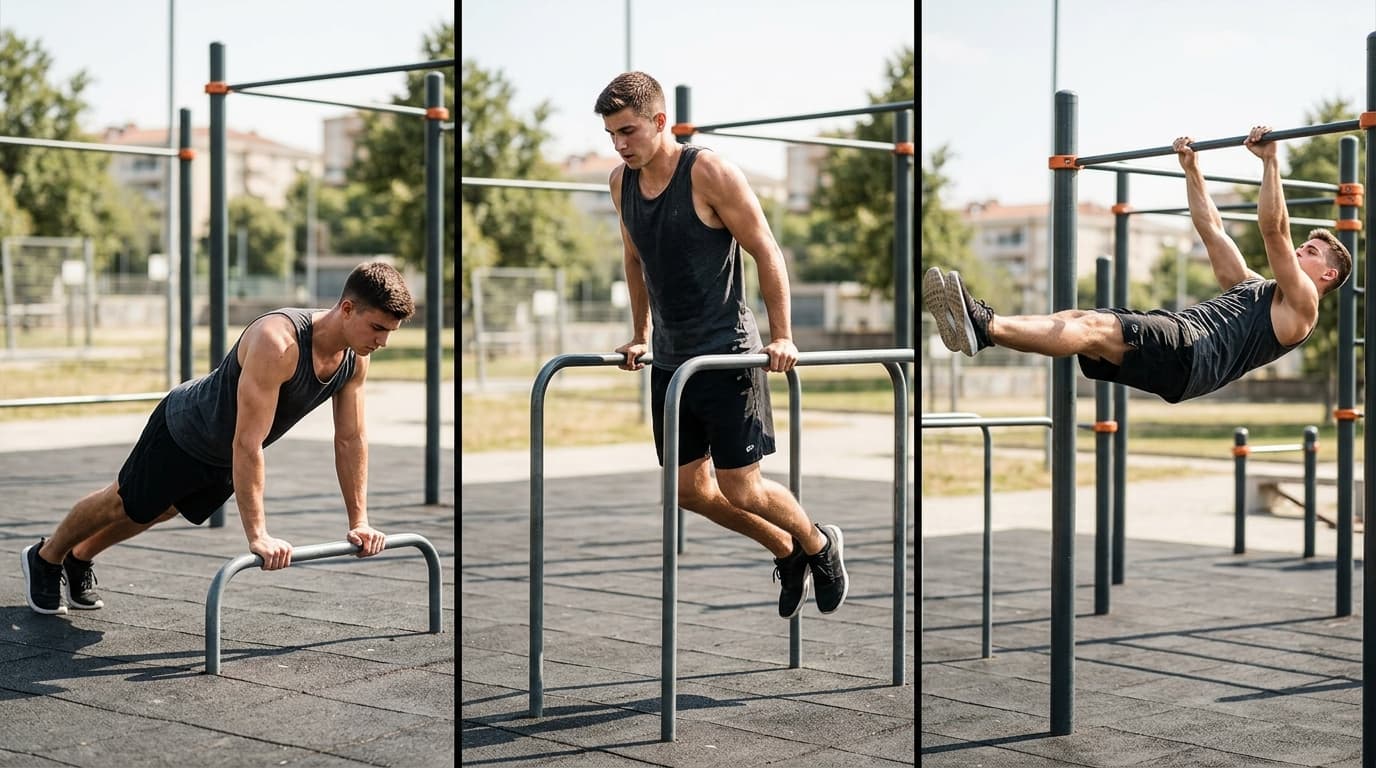
TL;DR: Calisthenics Results Timeline
- Weeks 1-2 (Neural Adaptations): Exercises feel easier, improved coordination, 10-20% strength gains from nervous system improvements. No visible physical changes.
- Weeks 3-4 (Early Strength Gains): 30-50% strength increases in basic movements, slight muscle definition, improved form and endurance. Muscle growth begins but minimal visibility.
- Weeks 6-8 (Visible Changes): Noticeable muscle definition, measurable body composition changes, 2-4 lbs muscle gain possible, visible progress in photos. Others may notice changes.
- Weeks 10-12 (Transformation Zone): Clear physical transformation, significant strength gains, ability to perform advanced variations, 4-8 lbs muscle gain possible. Consistent training creates lasting results.
- Key factors affecting timeline: Training frequency (3-5x/week optimal), progressive overload consistency, nutrition quality (protein and calories), sleep (7-9 hours), starting fitness level, and genetics.
Setting Realistic Expectations: The Truth About Calisthenics Results
Direct Answer: Most people see measurable strength gains within 2-4 weeks, visible muscle definition changes within 6-8 weeks, and significant body transformation within 10-12 weeks of consistent calisthenics training (3-4 sessions per week). However, the timeline varies significantly based on starting fitness level, training quality, nutrition, recovery, and genetics.
The question "how long until I see results?" is the most common question beginners ask, and unfortunately, the fitness industry often provides unrealistic answers. You've seen the "30-day transformation" ads and dramatic before-after photos. The reality is more nuanced—and actually more encouraging when you understand what's happening inside your body.
Results happen on multiple timelines simultaneously:
- Neural adaptations (improved coordination, feeling stronger): 1-2 weeks
- Actual strength gains (more reps, harder variations): 2-4 weeks
- Early muscle growth (measurable but not highly visible): 4-6 weeks
- Visible body composition changes (you notice in mirror/photos): 6-8 weeks
- Transformation (others notice, clear physical changes): 10-12 weeks
According to Sale's foundational research on neural adaptation to resistance training, published in Medicine & Science in Sports & Exercise, untrained individuals see their fastest strength gains in the first weeks of training, driven almost entirely by the nervous system learning to activate muscle more efficiently rather than by muscle growth. This "beginner gains" phase is when progress feels fastest. After 3-6 months, adaptation rates slow but remain consistent with proper progressive overload.
"The people who ask us 'when will I see results' in week 2 are almost always the same people who quit in week 4—right before the visible changes show up. The ones who make it past week 6 stop asking the question entirely, because by then they can see it for themselves."
Weeks 1-2: Neural Adaptations and Foundation Building
What happens: During your first two weeks, the most significant changes occur in your nervous system, not your muscles. Your brain learns to recruit muscle fibers more efficiently, coordinate complex movements, and activate stabilizer muscles. This neural adaptation accounts for 80-90% of early strength gains.
What You'll Experience
- Exercises feel 10-20% easier by week 2 (without muscle growth)
- Improved coordination and movement patterns (form gets cleaner)
- Muscle soreness (DOMS) peaks around day 2-3 after first session
- Increased energy and better sleep quality
- Mental benefits: improved mood, reduced stress, sense of accomplishment
- Ability to add 2-3 reps to baseline exercises
What You Won't See Yet
- Visible muscle growth (requires 4-6 weeks minimum)
- Scale weight changes (water retention may mask fat loss)
- Dramatic body composition changes visible in photos
- Ability to perform significantly harder exercise variations
- Comments from others about physical changes
Weeks 3-4: Early Strength Gains and Habit Formation
What happens: By week 3-4, neural adaptations are solidified and actual muscle protein synthesis begins ramping up. This is when you transition from "learning movements" to "building strength." Early muscle growth starts but remains mostly invisible. Most importantly, this is when training either becomes a habit or falls apart—consistency matters more than intensity.
| Metric | Week 1 | Week 4 | % Improvement |
|---|---|---|---|
| Max Push-ups | 8 reps | 12-15 reps | +50-87% |
| Max Squats (1 min) | 20 reps | 30-35 reps | +50-75% |
| Plank Hold | 30 seconds | 60-90 seconds | +100-200% |
| Inverted Rows | 5 reps | 8-12 reps | +60-140% |
| Muscle Gain | 0 lbs | 0.5-1 lb | (Mostly invisible) |
Weeks 6-8: Visible Physical Changes Begin
What happens: This is the breakthrough phase. The accumulated muscle protein synthesis from weeks 1-6 becomes visually apparent. Muscle definition improves noticeably, body composition shifts become measurable, and progress photos show clear changes. This is when training shifts from "am I making progress?" to "I'm definitely making progress."
What You'll See (Weeks 6-8)
- Noticeable muscle definition: Shoulder caps, chest separation, arm definition visible
- Progress photos show clear difference compared to week 1 baseline
- Body measurements change: Arms +0.5-1 inch, chest +1-2 inches, waist -0.5-1 inch (if losing fat)
- Clothes fit differently: Shirts tighter in shoulders/chest, pants looser in waist
- Others notice: Friends/family may comment on looking fitter or stronger
- 2-4 lbs muscle gain possible (0.25-0.5 lb per week average)
Performance Improvements
- First pull-up achieved (if training pull-up progressions)
- Push-up variations: Progress to diamond, decline, or archer push-ups
- Endurance doubles: Sets of 20-30 reps in exercises that were 10-12 reps at week 1
- Core strength: Plank holds 2-3 minutes, L-sit attempts, toes-to-bar progressions
- Workout capacity: Can handle higher volume (4-5 sets vs. 3 sets initially)
Weeks 10-12: Transformation Zone and Momentum Building
What happens: By weeks 10-12, you've completed a full training mesocycle. This is transformation territory—the physical changes are undeniable, strength gains are substantial, and you've built exercise variations that were impossible at week 1. Importantly, training is now habitual, not something requiring massive willpower.
| Metric | Week 1 | Week 12 | Improvement |
|---|---|---|---|
| Max Push-ups | 8 reps | 25-35 reps | +212-337% |
| Pull-ups | 0 reps (negatives only) | 5-10 reps | First pull-up achieved |
| Plank Hold | 30 seconds | 2-3 minutes | +300-500% |
| Pistol Squats | Impossible | 3-5 reps (assisted) | New skill unlocked |
| Lean Mass Gain | Baseline | +4-8 lbs | ~0.3-0.7 lb/week |
| Body Fat % | Baseline | -2-4% | (If in deficit) |
Months 4-6: Advanced Progress and Skill Development
What happens: After the rapid beginner gains of months 1-3, progress becomes more gradual but continues steadily. Months 4-6 are about refining physique, developing advanced calisthenics skills, and building the strength base for elite movements.
Physical Development (Months 4-6)
- Additional 3-6 lbs muscle gain (total 8-14 lbs from baseline)
- Muscle maturity: Fuller, more developed muscle bellies with better separation
- Definition at higher body fat: Visible muscle even without extreme leanness
- Proportional development: Balanced physique from full-body training
- Postural changes permanent: Naturally upright posture from strong posterior chain
Skill Milestones (Months 4-6)
- Weighted pull-ups: Adding +10-25 lbs to pull-ups
- Handstand holds: 30-60 second wall handstands, freestanding attempts
- Muscle-up progressions: Explosive pull-ups, bar transitions
- One-arm push-up progressions: Archer push-ups, assisted one-arm
- L-sit to V-sit progressions: Advanced core strength demonstrated
- Pistol squats: 5-10 reps per leg unassisted
7 Factors That Accelerate or Delay Results from Calisthenics
Individual results vary significantly based on these key variables. Understanding and optimizing them accelerates progress:
How to Track Your Calisthenics Progress Effectively
Tracking progress accurately prevents frustration and maintains motivation. The scale alone is a terrible progress metric for bodyweight training—muscle gain and fat loss can happen simultaneously, making weight misleading. Use multiple tracking methods:
Performance Metrics (Most Reliable)
Track monthly: Objective strength and endurance measurements that directly reflect adaptation.
- Max push-ups in one set (to failure)
- Max pull-ups in one set
- Max bodyweight squats in 2 minutes
- Plank hold duration (max time)
- Dead hang duration (grip strength)
- Exercise variations achieved (first pull-up, first pistol squat, etc.)
Progress Photos (Highly Motivating)
Take every 2-4 weeks: Visual changes often appear before measurements shift.
- Same time of day (morning, fasted, consistent)
- Same lighting and location (natural light preferred)
- Same poses: front relaxed, front flexed, side, back
- Same clothing (or shirtless for men, sports bra for women)
- Compare photos side-by-side (not just looking in mirror)
Body Measurements
Measure biweekly: Circumference changes indicate muscle gain and fat distribution shifts.
- Chest (at nipple line, relaxed): indicates upper body development
- Arms (at largest point, flexed): biceps/triceps growth
- Waist (at belly button, relaxed): indicates fat loss/gain
- Thighs (at largest point): leg development
- Shoulders (around widest point): overall frame development
- Expected changes: +0.5-1 inch on arms/chest over 12 weeks, -0.5-2 inches on waist (if losing fat)
Workout Logs (Essential)
Record every session: Progressive overload requires knowing what to progress from.
- Date of workout
- Exercise variation (specific name: "diamond push-ups" not just "push-ups")
- Sets performed and reps per set
- Rest time between sets
- Tempo if using controlled speed
- RPE (Rate of Perceived Exertion) 1-10 scale
- Notes: form quality, energy level, any difficulties
Odin automatically tracks all workout data, exercise progressions, and performance benchmarks.
Common Mistakes That Delay Results from Calisthenics
Unrealistic Timeline Expectations
The Mistake: Expecting dramatic transformation in 2-4 weeks based on misleading marketing. Getting discouraged and quitting when visible changes don't appear immediately.
The Fix: Understand the real timeline: neural gains (1-2 weeks), strength gains (2-4 weeks), visible changes (6-8 weeks), transformation (10-12 weeks). Commit to 12 weeks minimum before evaluating results. Focus on performance improvements (more reps, better form) during weeks 1-6 when visual changes are minimal. Trust that body composition changes lag behind strength gains.
Inconsistent Training Frequency
The Mistake: Training 5 times one week, then skipping the next week entirely. Sporadic effort produces sporadic results. Muscle adaptation requires consistent stimulus—gaps longer than 5-7 days cause detraining.
The Fix: Commit to minimum viable consistency: 3 sessions per week, every week, for 12 weeks. Schedule sessions in advance like appointments. If you miss one session, continue the schedule—don't try to "make up" workouts. Life happens; 3 consistent sessions per week beats 6 erratic sessions every other week.
No Progressive Overload (Repeating Same Workout)
The Mistake: Doing identical workouts for months without increasing difficulty. Example: 3 sets of 10 push-ups every session for 12 weeks. After initial adaptation (week 3-4), further progress stops completely.
The Fix: Systematically increase difficulty every 1-2 weeks: add reps (10→12), progress to harder variation (regular→diamond push-ups), slow down tempo (3-second negatives), add sets (3→4), or reduce rest time (2 min→90 sec). Track workouts to ensure progression. Your body adapts to stress—if stress doesn't increase, adaptation stops.
Inadequate Protein Intake
The Mistake: Training hard but consuming insufficient protein (less than 0.5g per pound bodyweight). Without adequate protein, muscle protein synthesis is severely limited—you provide training stimulus but not building blocks.
The Fix: Consume 0.7-1g protein per pound of bodyweight daily (140-200g for a 200 lb person). Spread across 3-4 meals throughout the day. Prioritize protein sources: chicken, fish, eggs, Greek yogurt, protein powder, legumes. This single change can accelerate results by 30-50% compared to low protein intake.
Insufficient Sleep and Recovery
The Mistake: Training hard but sleeping 5-6 hours per night. Growth hormone (primary muscle-building hormone) peaks during deep sleep stages. Inadequate sleep reduces muscle protein synthesis by up to 30%.
The Fix: Prioritize 7-9 hours of quality sleep nightly. Establish consistent sleep schedule (same bedtime/wake time). Create sleep-conducive environment: dark, cool (65-68°F), minimal noise. Avoid caffeine after 2pm and screens 1 hour before bed. Rest days are training days—muscles grow during recovery, not during workouts.
Only Tracking Scale Weight
The Mistake: Using scale weight as sole progress metric. Getting discouraged when weight doesn't change despite muscle gain and fat loss happening simultaneously (body recomposition). Scale weight can stay identical while body composition transforms dramatically.
The Fix: Use multiple tracking methods: performance benchmarks (max reps, exercise progressions), progress photos (every 2-4 weeks), body measurements (circumferences), and workout logs. The scale is one data point among many. Many people gain 5 lbs of muscle and lose 5 lbs of fat over 12 weeks—scale shows no change, but mirror shows transformation.
Comparing to Unrealistic Transformations
The Mistake: Comparing your 8-week progress to heavily edited "30-day transformation" ads featuring dramatic lighting changes, photo manipulation, or individuals with years of training history. Feeling like you're failing when your results don't match unrealistic standards.
The Fix: Compare yourself to yourself. Your week 1 vs. week 8 photos are the only comparison that matters. Understand realistic timelines: 4-8 lbs muscle gain in first 12 weeks is excellent. Visible definition changes in 6-8 weeks is normal. Real transformation takes 3-6 months minimum. Progress is progress—celebrate your improvements without comparing to others' highlight reels.
Frequently Asked Questions
Can you see results from calisthenics in 2 weeks?
How long does it take to build muscle with calisthenics?
What should I expect after 30 days of calisthenics?
Why am I not seeing results from bodyweight training?
Is 30 minutes of calisthenics a day enough to see results?
How long until calisthenics becomes easier?
Start the Weekly Plan Behind Your Results
Choose a schedule you can maintain, and Odin will build progressive bodyweight sessions around your goal and current level.
Build My Free Weekly Plan